
Certainty is the Scarcest Commodity: Canada in a New Geopolitical Age
March 30, 2026
The world order is shifting in real time. Trade agreements, security pacts and strategic alliances, the foundation on which the international order was built, are fraying. Conflicts in the Middle East and Europe are disrupting supply chains and energy markets.
The shifting geopolitical landscape has significant consequences for Canada's economy, its relationship with the United States and its position on the global stage. In the words of Carol Wilding, FCPA, FCA, ICD.D., President & CEO of CPA Ontario, “Canada can no longer take our security, prosperity and sovereignty for granted.”
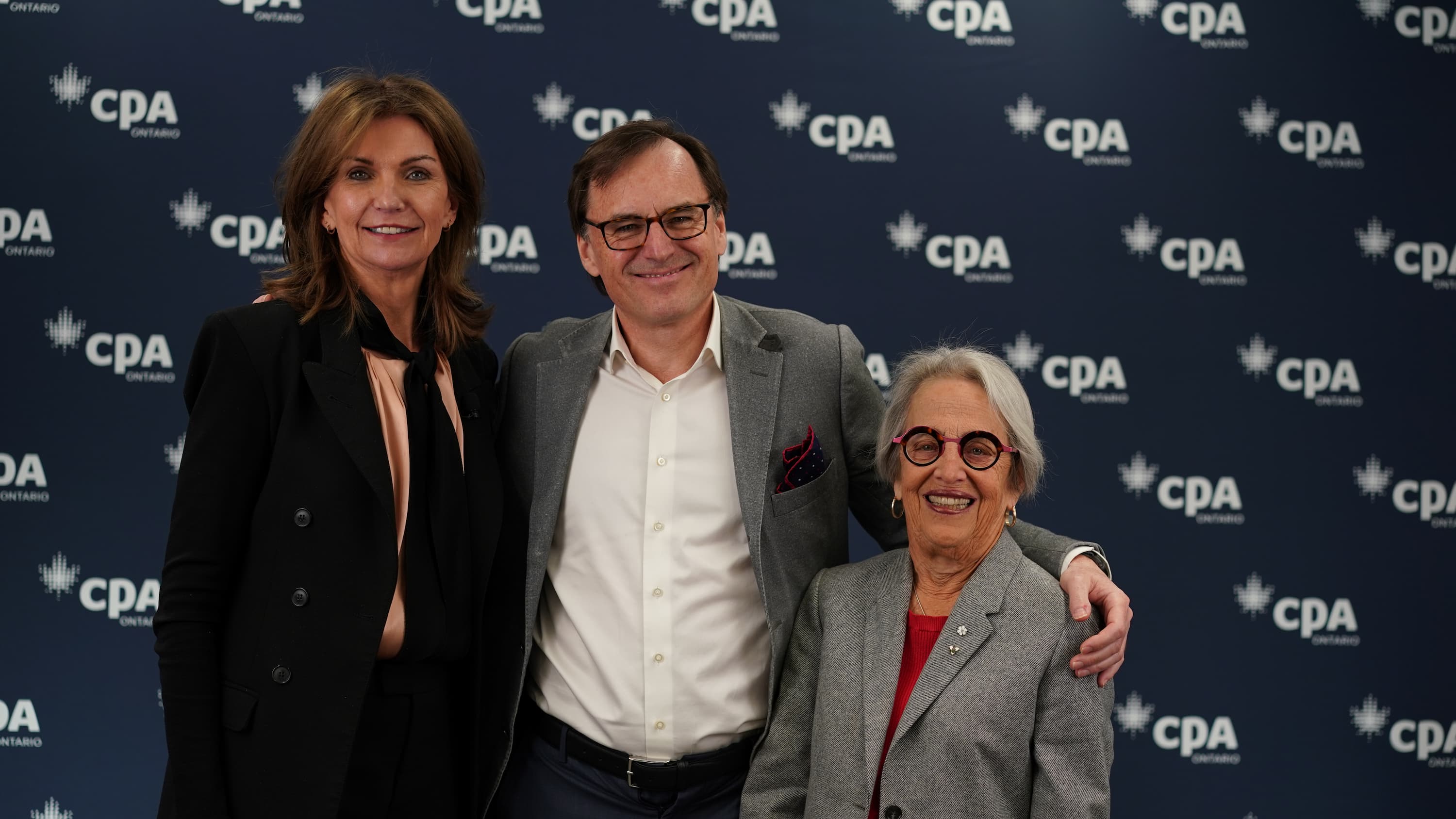
CPAs will play an important role in helping Canada navigate whatever comes next. That’s why CPA Ontario recently invited two of the country’s leading geopolitical minds to our Insights Speakers Series stage to share their thoughts with CPA Ontario members and students.
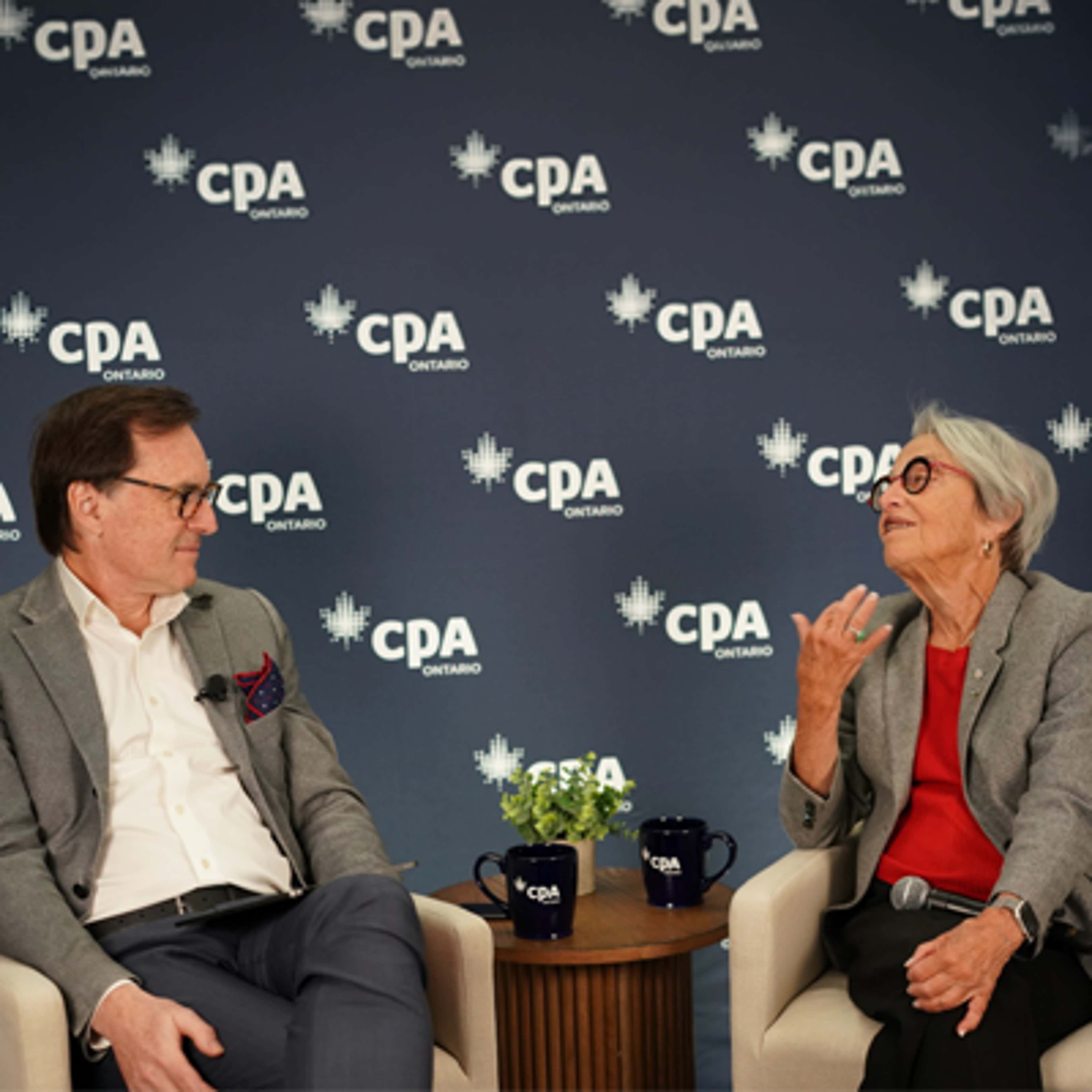
Professor Janice Gross Stein, Founding Director of the Munk School for Global Affairs and Public Policy at the University of Toronto, has spent decades analyzing the forces that shape the global order and their consequences for Canada. She sat down with Rudyard Griffiths, co-founder of the Munk Debates and publisher of The Hub, for a timely discussion on what this moment means for the country and the profession.
Three Takeaways for CPAs
1. Shocks to the system affect all industries
Citing analysis from the International Energy Agency, Professor Stein characterizes the war between Iran, the U.S. and Israel, the destruction of key energy infrastructure in the Middle East and the disruption of shipping routes through the Strait of Hormuz as the biggest energy shock in recent history. “This is the biggest energy shock we’ve had in the modern oil economy,” she says. “It’s bigger than 1973 and 1979 combined. If no additional energy infrastructure is destroyed in this war, it is already bigger.”
But there are also impacts beyond energy. When asked which other Canadian industries would be most affected by current geopolitical conflict, Stein and Griffiths answered simply “everything”; supply chain disruption with its consequential ripple effects will impact all Canadian industries.
Professor Stein gave two examples. In addition to the energy industry, Liquified Natural Gas shortages will impact the manufacturing of computer chips, which our digitally powered economy, not to mention AI and smartphones, rely on. Shortages of fertilizer will affect the spring planting season and drive up food costs. Global supply chains may have been instrumental in building prosperity, but they have also become a risk factor as nations look to leverage the interconnected nature of the world economy to achieve their own strategic goals.
2. You can't diversify away from geography – but Canada does have advantages
One of the biggest sources of potential risk for Canada is right next door.
Historically, Professor Stein pointed out, it has been easy for Canada to “shelter under the umbrella” of our closest neighbour and benefit from shared language, ease and stability of cross-border investment and proximity to the world’s most dynamic economy.
While this was a rational approach at the time, today there is no country in the world that is as exposed to a single trading partner as Canada is to the U.S. And while there has been a recent push to diversify trading relationships, barriers like language, regulatory structures and understanding the players in a new market make it very difficult. While there are new risks to trade with the U.S., some business leaders may still prefer to play the odds and stick with them.
Ten years from now, Stein and Griffiths predict, the U.S. will still be a significant trading partner for Canada. As the discussion about the renewal of the Canada-United States-Mexico Agreement (CUSMA) proceeds, it's important to keep our options open.
It is also important to remember that Canada does have leverage in this renegotiation. Canada produces assets like uranium, fertilizer and electricity that the U.S. needs. And there is also a crucial security advantage – the U.S. cannot defend the Northern Hemisphere without Canada.
3. Uncertainty demands a new way of thinking for CPAs
In a world where “certainty is the scarcest commodity,” Professor Stein observes that measuring risk can be difficult. A challenge is that “we keep thinking in terms of risk where we can estimate the probabilities, and neglect uncertainties.” And why does that matter? According to Professor Stein, “When you're in a world of uncertainty...you can't actually estimate probabilities. You need new ways of thinking."
She recommends CPAs tell themselves two or three plausible stories about how things could go, then track the indicators to see which way events are trending. In advising clients, it may be necessary to say, as Professor Stein does to government and private sector leaders, “I don’t know right now – here’s what’s possible.”
Rather than attempting to calculate the likeliest outcome, CPAs must plan for multiple scenarios and use strategies that will help them navigate across them. “When you’re advising CEOs or clients, the biggest trap, in this world, is false certainty,” she says – and it’s something worth resisting.
The Path Forward
Professor Stein’s advice to CPAs? “Grow your tolerance for uncertainty.” To use her recommended methodology, there are multiple possible stories for Canada’s future. The question is whether we will "come out stronger, more innovative, more adaptive once the easy road is closed."
Despite uncertainty, there are steps Canada can take to make that outcome more likely. By focusing on what we can control, like building our capacity here at home, reforming our tax system, and supporting innovators and entrepreneurs, Canada can transform its economy to meet this moment.
And CPAs have an important part to play. By driving the adoption of AI, helping scale Canadian ideas into international success stories, and opening up new markets for our resources, goods and services, CPAs are leaders steering Canada in a positive direction.
“We know we are living in a more volatile, unstable and unpredictable world,” said Wilding, “But knowing is only half the battle. The other half is to act.”