


Economic Outlook 2026: Five Trends for CPAs to Watch For
January 15, 2026
Canada’s economy may have proven resilient through a turbulent 2025, but that doesn’t necessarily mean that we have reached “Canada Strong.” At least, not yet.
That was the conclusion at this year’s Economic Club of Canada 2026 Economic Outlook Breakfast. Moderated by CTV Chief Political Correspondent Vassy Kapelos, the panel of leading Canadian economists, included:
- Beata Caranci, Chief Economist and Senior Vice President, TD Bank
- Frances Donald, Chief Economist and Senior Vice President, RBC
- Stéfane Marion, Chief Economist and Strategist, National Bank of Canada
- Jean-Francois Perrault, Chief Economist and Senior Vice President
- Douglas Porter, Chief Economist and Managing Director, BMO Financial Group
- Avery Shenfeld, Chief Economist and Managing Director, CIBC
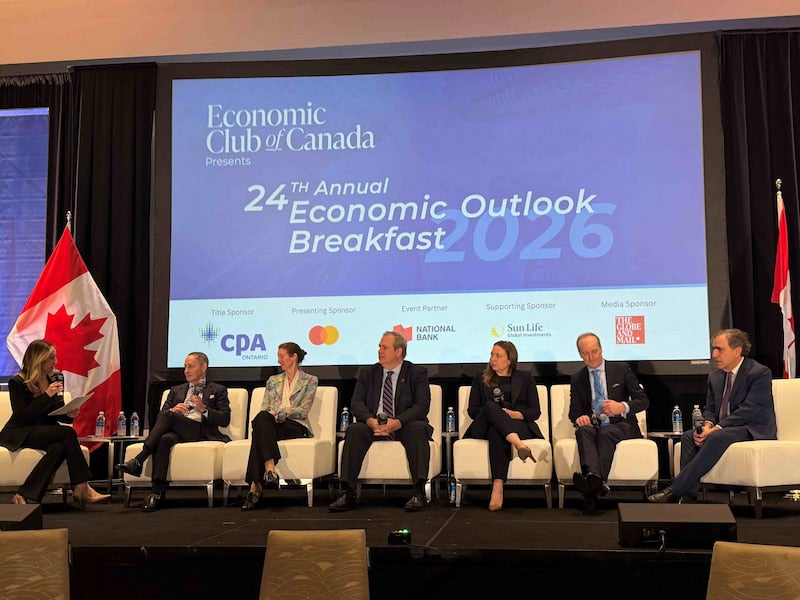
Canada avoided a recession in 2025, and the panelists projected slow to moderate growth in the year ahead. But the current moment, from geopolitical uncertainty to weak productivity and competitiveness, demands bold ideas and the determination to see them through.
If uncertainty was the watchword of 2025, then action will be the priority for the coming year.
Based on the discussion at the Economic Club of Canada, here are five trends for CPAs to watch for in the coming year.
Subscribe to the CPA Ontario Insights Newsletter
Public policy and thought leadership for CPAsSign up on LinkedIn3. Canada’s Policy “Tone Shift”
The panelists applauded the change in tone from Ottawa, with an increased focus on investment and economic performance, noting that that the MOU with Alberta and the federal budget in November were steps in the right direction.
However, they noted that the past year has been more about removing bad policy than making good policy. Canada’s persistently weak investment and productivity will require moving beyond tone to tangible action.
Tax Policy
That includes reforming Canada’s personal and corporate tax system. Beata Caranci laid out the case that, while considered a “third rail” of Canadian politics, Canada’s personal and corporate tax system needs reform, a perspective that aligns with CPA Ontario’s recommendations in Tax Reform for Growth in Canada. She gave the small business tax rate as an apt example; a large gap between general and small business rates has created a disincentive for firms to grow. Instead, they aim remain below the small business deduction threshold. A recent Statistics Canada study proves this out, showing that firms cluster just at or below the $500,000 taxable income limit, creating a significant problem in a country where over 90% of all businesses are small businesses.
Another sticking point raised is that Ontario’s top income tax brackets are not indexed to inflation and have not been updated in over 10 years. The result is “bracket creep,” where taxpayers are moving into higher tax brackets with no actual increase in their purchasing power.
Monetary Policy
Another shift in the policy landscape is the shift away from monetary policy to economic policy. When asked about whether an interest rate cut is in the offing for the coming year to help boost growth, the panel pointed to Bank of Canada Governor Tiff Macklem’s comments that the role that monetary policy can play is now limited. While there was some disagreement on whether interest rates will stay the same or even go up in the coming year (there was consensus that they are not expected to go down), there was broad agreement that the real challenges to growth are investment and productivity, not interest rates.
The ball is now squarely in the federal government’s court. Monetary policy will not solve Canada’s growth problem. Only sound economic policy can.
5. AI: Boom or Bubble?
Another major trend to watch in the coming year will be the artificial intelligence. The question was put to the panel on whether the explosive growth of investment in AI and the build out of data centers represented a “bubble.”
The panel put forward that equity markets in Canada and the U.S. are not necessarily in bubble territory yet, and there was agreement that AI isn’t a flash in the pan like the Metaverse – it’s here to stay. But every new technology creates a crowded marketplace, which inevitably leads to consolidation down the road. Instead of a bubble pop, the panel anticipated that eventually, there may be a pullback in investment as the “winners” in the AI race become clear.
More worrying is how AI could be transforming the labour market. While the projected mass layoffs due to AI have not materialized, young people under 25 are experiencing a much higher rate of unemployment, which may be because businesses are reticent to hire entry level workers. The implications for the broader economy are far reaching, but more data is needed to understand if these two trends are connected.