


How Can CPAs Thrive in the Age of AI?
April 17, 2026
What if disruption wasn’t something to survive, but something to grow from?
That’s the premise behind anti-fragility, created by author Nassim Nicholas Taleb in his 2012 book “Antifragile: Things That Gain From Disorder.” The concept describes systems that thrive, grow, and improve when exposed to stress, volatility and disorder. As Taleb puts it: "The resilient resists shocks and stays the same; the anti-fragile gets better."
For CPAs navigating AI disruption, it’s a concept worth considering.
The idea of anti-fragility has spread beyond academia into business, management, technology and risk assessment. It came up repeatedly at a recent CPA Ontario event for emerging leaders, where three speakers, Brice Scheschuk, CPA, CA, managing partner at Globalive Capital; Dr. Jodi Lobana, FCPA, FCA, an AI governance expert, author and academic; and Narbe Alexandrian, CPA, CA, founder and CEO of Define Capital. Their collective message was consistent: thriving in this new AI world doesn’t mean the CPA skill set is defunct. It will mean evolving how you use it so that you can spend more time on higher-value work.
Why Does Anti-Fragility Matter for CPAs?
The WEF's Future of Jobs Report lists accountants and auditors among many of the roles expected to see significant disruption from AI. Companies aren’t just giving employees access to AI tools; they’re hiring AI. McKinsey CEO Bob Sternfels recently revealed that his firm now counts 25,000 AI agents alongside 40,000 humans, treating each agent not as a tool, but as an independent member of the workforce.
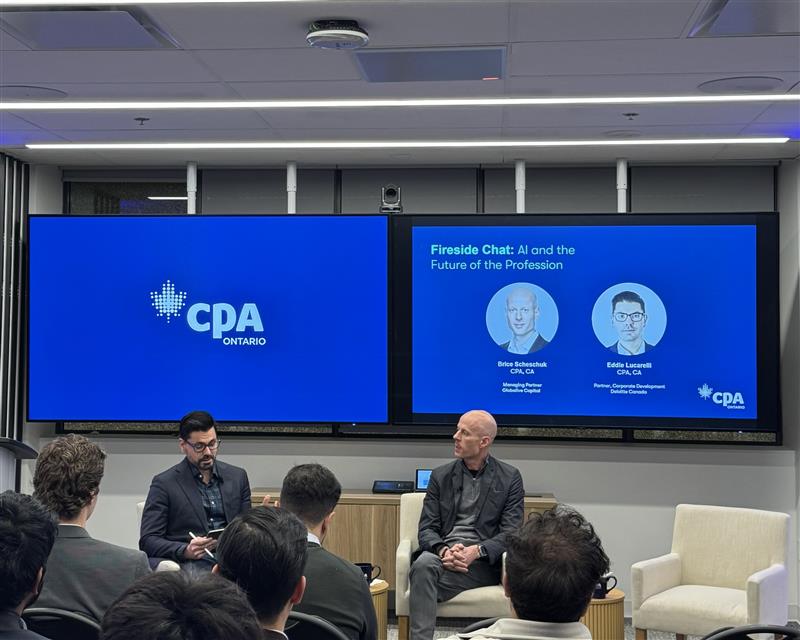
But disruption and opportunity are two sides of the same coin. Alexandrian was direct on this point: "It's actually going to help you out. Your focus is on how do I increase my productivity and how do I do more for my company. It’s the best productivity tool we've ever seen." Scheschuk shared the example of Espresso Capital, a Canadian fintech lender, whose team described using an AI model for FP&A analysis that started at analyst level in skill, progressed to associate, and is now tracking toward director; a progression that happened in months, not years.
Capturing that upside isn’t automatic. Scheschuk’s advice is to stay close to the tools, keep adding value, and build the kind of adaptability that lets you respond well to whatever comes next. The goal, he said, is "being resilient and anti-fragile to be able to bounce with it." Don't just survive the volatility. Use it.
Shadow AI
AI is reshaping how organizations work in ways both planned and unplanned. Employees have long used technology without their IT department's approval, knowledge, or oversight — a phenomenon known as "shadow IT.” Generative AI used the same way has earned a similar, and fitting name: “shadow AI.”
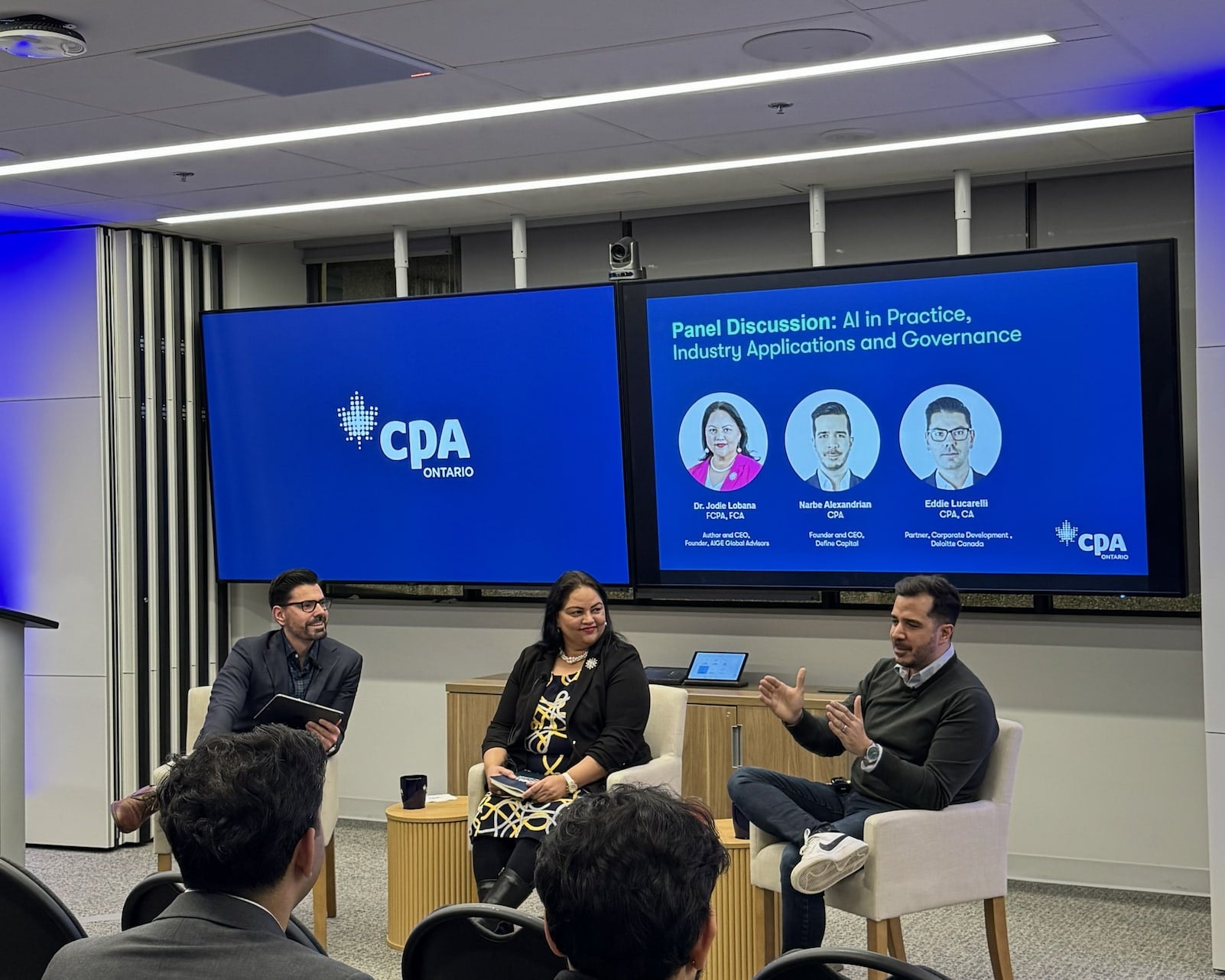
But if a growing number of your employees are using AI tools like Claude, Gemini or ChatGPT without formal approval, could this be a sign of a pent-up desire to innovate, rather than an ill-disciplined workforce? As Dr. Lobana suggested, if people are using IT tools not approved by management for productivity, companies should ask what they are doing that approved tools can’t.
But for CPAs, the risks of getting it wrong are far higher. Professional obligations around confidentiality, due diligence, and accountability still apply, no matter how convenient an AI tool might be. Using an unsanctioned system that exposes client data or signing off on AI-generated outputs without adequate review isn't just an IT policy violation, it can have serious consequences for the individual CPA, the organization they work for and the reputation of the profession as a whole. The lesson here is not to shut down the use of AI, but to use the fact that team members are using AI tools as the signal Dr. Lobana describes, and act on it quickly by putting proper governance in place. That means shifting from what Dr. Lobana calls a "fail and hide" culture to a "fail and learn" one, building systems that don't just withstand stress but improve because of it.
Keeping Humans in the Loop
Getting the right AI into the hands of the right people is only half the challenge. The other half is knowing when not to trust what it tells you. Clearly, given AI's tendency to “hallucinate," organizations need to keep a close eye on AI outputs; fact-checking, questioning assumptions, and understand each system's strengths and weaknesses. Dr. Lobana was blunt about the standard that applies: "In real estate they say location, location, location. For AI: review, review, review. Do not send anything outside unless you have reviewed it in detail."
This is where CPAs have a natural advantage. Deep expertise in financial reporting and auditing, an ethical mindset, critical thinking and communication; these are exactly the skills that make CPAs effective AI auditors and risk monitors. Success in this new environment requires a willingness to experiment, learn fast and be creative with the right foundation.
What Anti-Fragility Looks Like in Practice
What does anti-fragility actually look like on the ground? It's less a grand strategy than a set of deliberate habits: building redundancy in skills, embracing experimentation, and using AI to handle routine work so you can focus on the judgment and lateral thinking that AI can't replicate.
Alexandrian's example at Define Capital shows just how far this can go. At Define Capital, his team built an AI agent to source acquisition targets, scraping software review sites to identify bootstrapped companies, cross-referencing to filter out venture-backed firms, pulling CEO contact details, checking employee counts on LinkedIn, and then automatically sending a sequenced series of emails in Alexandrian’s own tone of voice. This entire process, which previously would have required a junior analyst to execute, now runs completely autonomously. “As soon as a human answers that email,” he said, “then we jump in.” The judgement layer stays human.
Artificial intelligence is top of mind for the entire profession, but for CPAs under 35 the conversation is not abstract. As the first “AI Generation of CPAs” Emerging leaders are immersed in AI tools every day, and they have the knowledge and expertise that senior leaders genuinely need. That kind of bottom-up insight is in itself a form of anti-fragility. Organizations that create space for it will adapt faster than those that don’t. Scheschuk experienced it firsthand at the event, getting an impromptu lesson on coding tools from one of the emerging leaders in the room. "It's reverse mentorship everywhere," he said.
While the tools are changing fast, the judgment, ethics, and intellectual honesty that define a great CPA haven't, and these skills have never been in higher demand.