

The driver of this shift? Intangible assets.
The global economy has transitioned to one where value and economic growth is generated by the commercialization of intellectual property (IP) and AI/data.
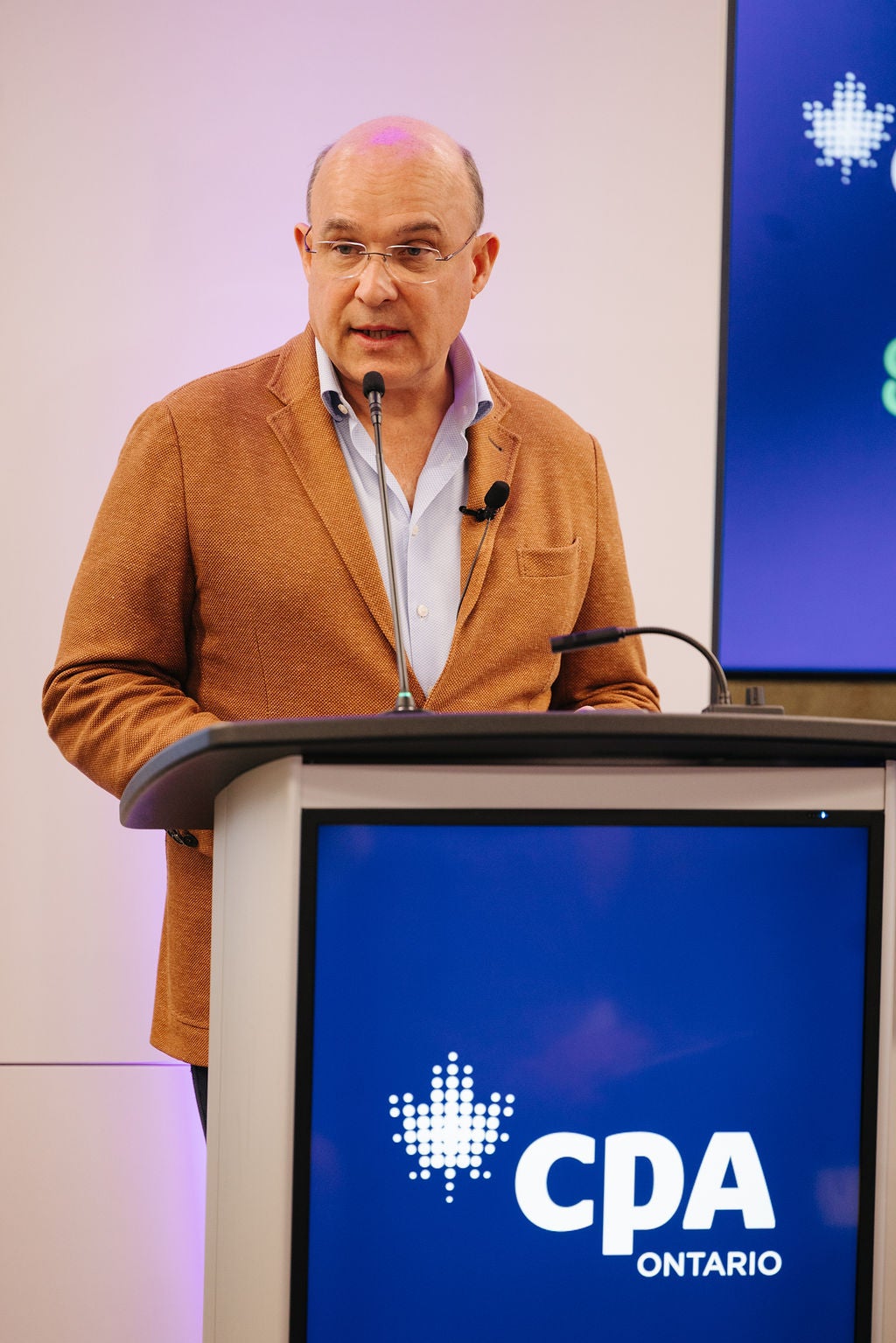
Canada’s economy has not kept pace with this transition and catching up is going to take a complete paradigm shift. At a recent fireside chat with CPA Ontario President & CEO Carol Wilding, FCPA, FCA, ICD.D., Balsillie laid out the case for why no other profession is better suited to tackle this challenge than CPAs.
“As the world transforms, the incentives for strategic behavior have increased dramatically,” said Balsillie. “CPAs are poised to play a central role in this transformation.”
The fact that Canada’s economic performance has been dragging behind its counterparts in the OECD should not come as a surprise to anyone who was paying attention to the data. Investment, productivity and competitiveness have been weak. According to Balsillie, if the Canadian economy had kept pace with the U.S. over the last 15 years, Canada would be $1 trillion annually richer.
The Fundamental Shift in the Global Economy
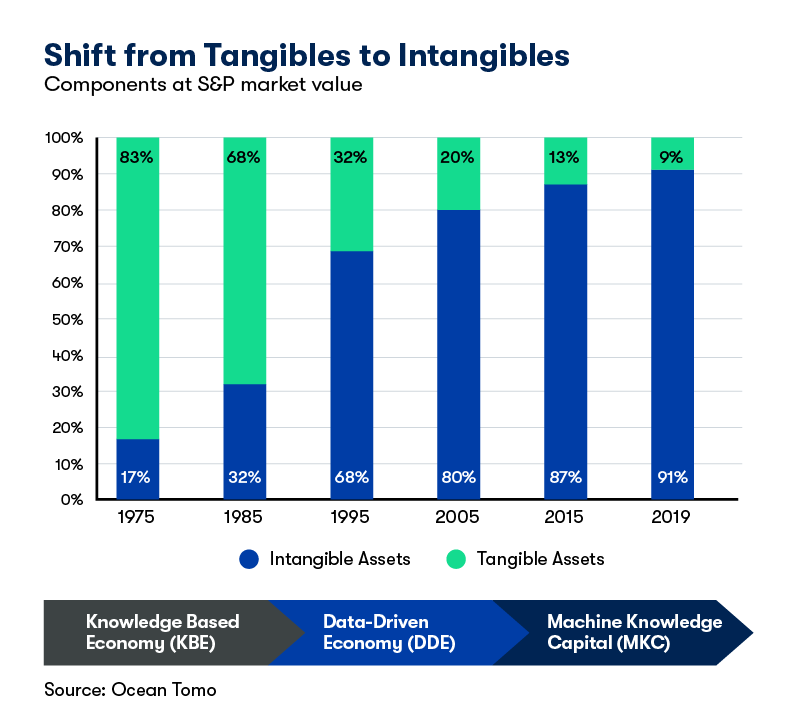
Since the 1970’s, the value of intangibles in the economy has risen dramatically. Once making up less than 20 per cent of the market value of the S&P 500, by 2019 that number had risen to the point where over 90% of all S&P market value is driven by intangible assets. By comparison, the value generated by tangible assets have declined from over 80% to less than 10%.
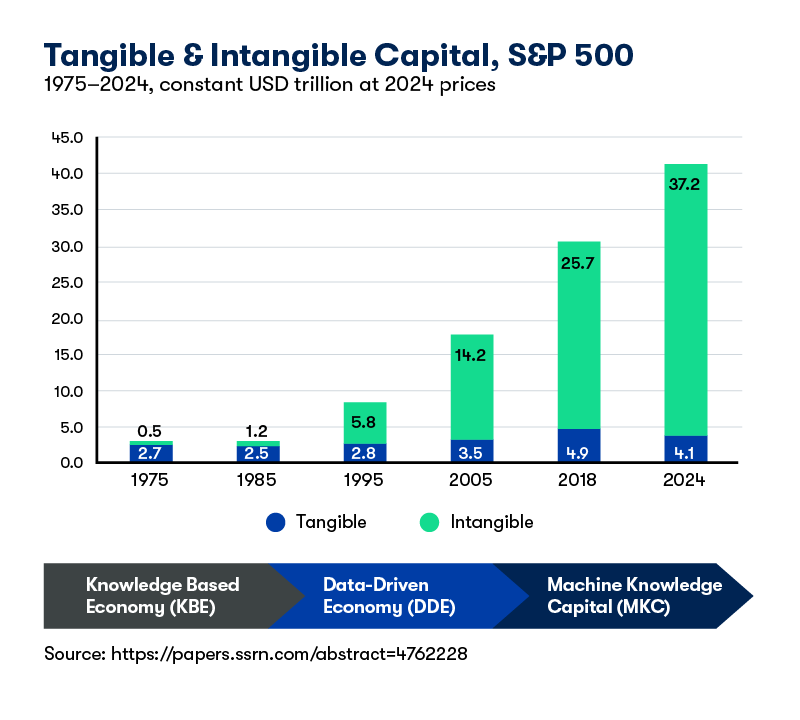
Likewise, the capital value of intangible assets has skyrocketed to over $37 trillion, when compared to just over $4 trillion in tangible assets.
So how has Canada benefitted from this IP “gold rush?”
It hasn’t.
While Canada leads in government funded research citations, ownership and commercialization of their ensuing innovations is weak. Balance of payments on patent rights has plummeted since the 1980s, and Canada is struggling in patent holdings in the very areas where Canada wants to lead, like AI, semiconductors and advanced manufacturing, according to recent research from the Conference Board of Canada.
While this may all seem somewhat abstract, according to Balsillie there are real world, tangible impacts for working Canadians. Canada trails the OECD in per-capita GDP growth, which means Canadians are, in effect, growing poorer, our standard of living is not keeping up, and the gap between the U.S. and Canada is widening.
According to Balsillie this is due in part to the fact that the Kaldor Ratio, an economic principle that states shares of national income received by labour and capital are roughly constant over long periods of time, is now broken. There has been a divergence between the percentage of national income going to capital, and the percentage now going to labour. The result is a shrinking percentage of national income going to workers.
He points to five structural forces responsible for this change:
- The shifting of labour to lower cost countries through traditional trade agreements
- The separation of tangible production and intangible value chain in the mid-90s
- The rise of the “precariat,” which undermines long-term worker security
- The emergence of the data driven “gig economy” and “attention economy” in the 2010s
- The explosion of machine learning capital in the modern economy, where AI is a new form of productive capital that competes with and compliments human experience

Boosting Canada’s standard of living will be dependent on capturing the value at both ends of the global intangible value chain, with R&D, design and AI compute on one end, and marketing and e-commerce at the other. Production and manufacturing now represent the lowest point of that curve.
Control of Canadian-made intangible assets is more than just an economic imperative for the country. It’s a national security and sovereignty imperative as well.
“The management and control of intangible assets shape both economic outcomes as well as a broad array of non-economic social and security outcomes,” said Balsillie.
That’s where the importance of frameworks, and CPAs background and understanding of standard setting, comes into play.